
Roof Ventilation & Ice Dam Prevention
If you get ice dams every winter, the roof is usually not the problem.
The attic underneath it is. Here is what actually causes them and how we fix it for good.
Have an ice dam right now?
We do emergency ice dam removal.
Call (781) 324-4312
Every February we get calls from homeowners with water coming through a bedroom ceiling and a row of icicles hanging off the gutter. Most of them assume the roof failed. Usually it did not.
Ice dams are caused by heat, not by bad shingles. That is why replacing a roof without dealing with what is underneath it often does not stop the problem, and why some homeowners end up paying for the same repair twice. Mark Brady Roofing has been working on New England roofs for 40 years, and ice dams are one of the most common things we get called about between January and March. This page explains what is actually going on up there.
What Causes Ice Dams
An ice dam forms when part of your roof is warm and part of it is cold at the same time.
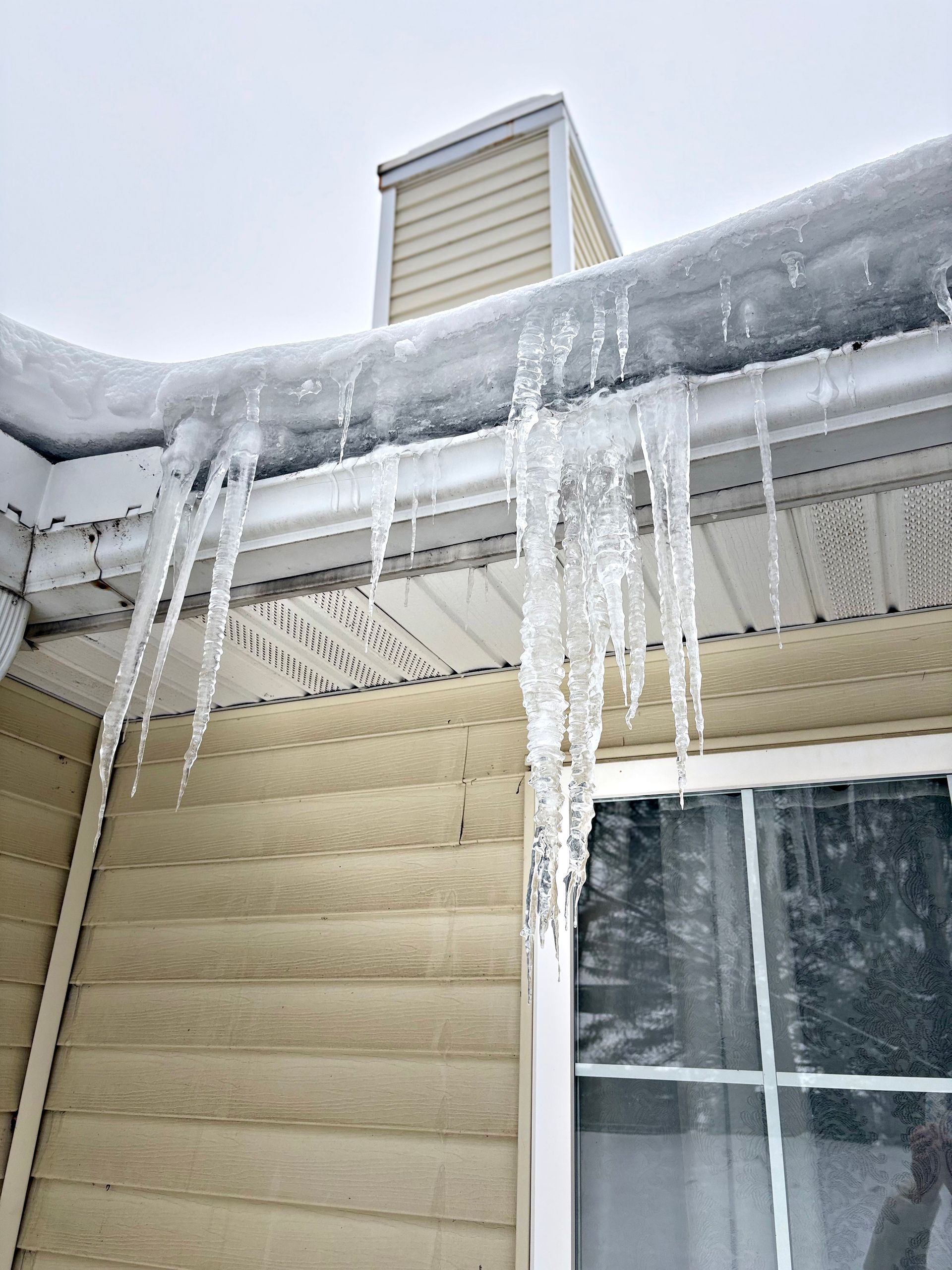
Heat escaping from the living space into the attic warms the underside of the roof deck. Snow sitting on that warm section melts, even when it is well below freezing outside. That meltwater runs down the roof until it reaches the eave, the section that overhangs the exterior wall. There is no heated space under the eave, so it is cold, and the water refreezes when it gets there.
Do that for a few days and you build a ridge of ice at the edge of the roof. Now the meltwater coming down behind it has nowhere to go, so it backs up and sits on the roof. Shingles are designed to shed water running downhill, not to hold standing water, so it works its way under them, through the deck, and into the house.
Three things make it worse:
- Not enough insulation, which lets more heat into the attic in the first place
- Poor or blocked ventilation, which traps that heat against the roof deck instead of carrying it out
- Clogged gutters, which hold ice and water right at the eave where the dam forms
That last one is why houses with heavy tree cover get ice dams worse than their neighbors. Gutters packed with leaves in November are frozen solid in January.
Why Ice Dams Are Not a Shingle Problem
This is the part that costs homeowners money.
If a roofer looks at your ice dam and quotes you a new roof, ask what he plans to do about the attic. New shingles on top of the same trapped heat will melt snow exactly the same way the old ones did. You will get a good-looking roof and the same leak next winter.
The roof is where the damage shows up. The attic is where the problem lives. Any fix that does not deal with airflow and insulation is treating the symptom.
There is one thing the roof itself genuinely contributes, and it is worth doing: ice and water shield at the eaves. That is a rubberized membrane that goes down before the shingles and seals around the fasteners. It does not stop ice dams from forming, but it stops the backed-up water from getting into the house when they do. Massachusetts code requires it, and we run it well past the minimum on houses that have a history of dams.
Emergency Ice Dam Removal
If you have water coming in right now, the first job is getting the ice off. We do emergency ice dam removal for homeowners in Malden and the surrounding towns.
We remove ice dams with steam. A roof steamer melts the ice with low pressure and high temperature, which cuts a channel through the dam and lets the trapped water drain. It takes longer than swinging a hammer at it and it costs more, and it is the only method that gets the ice off without wrecking the roof underneath.
What we will not do, and what you should not let anyone else do either:
- Chipping with an axe, hatchet, or hammer. This is still the most common way ice dams get removed and it breaks shingles every time. You end up paying for roof repair in the spring on top of the ice damage.
- Pressure washing. A pressure washer is cold water at high force. It strips granules off shingles and drives water up under them. A steamer is the opposite, hot water at low pressure, and the two are not interchangeable no matter what somebody with a power washer tells you in February.
- Rock salt straight on the roof. It corrodes flashing, gutters, and fasteners, and it kills whatever is planted underneath. Calcium chloride is the safer choice if something has to go up there.
What happens after. Removal is a stopgap. It stops the water today, it does not stop the dam from coming back in three weeks, and it does not fix why the roof is melting snow in the first place. Once the weather turns we will come back, look at the attic and the ventilation, and give you a real fix. Homeowners who only ever call for removal end up paying for it every single winter.
Book it before you need it. During a bad stretch every roofer in the area is booked solid and people wait days with water coming in. If your house dams up most winters, it is worth calling in the fall rather than during the storm.
How We Fix It
Intake and exhaust, working together. Ventilation only works as a system. Air has to come in low at the soffits and leave high at the ridge. Plenty of houses have a ridge vent but blocked or painted-over soffit vents, which means there is nothing feeding it and the ridge vent is doing very little. We check both ends.
Baffles at the eaves. In a lot of attics the insulation has been pushed right out to the edge, which blocks the soffit vents completely. Baffles hold that channel open so air can actually move from the soffit up the underside of the roof deck.
Ridge venting. On a replacement we cut the ridge and install continuous ridge vent, which pulls warm air out along the entire peak rather than through a couple of box vents.
Ice and water shield past the code minimum. Standard practice is a run at the eaves. On a house with a real ice dam history we go further up, and we run it in the valleys, which are the other place backed-up water gets in.
Gutters that actually drain. If water cannot leave the roof it will find a way in. Sometimes the fix is as simple as gutters that are the right size and pitched properly.
Being honest about what is not our work. Some ice dam problems are mainly an insulation and air sealing job, and that is an insulation contractor rather than a roofer. If that is what your house needs, we will say so instead of selling you the part we happen to install.
Ventilation and Your Shingle Warranty
Most homeowners do not know this one. Shingle manufacturers require adequate attic ventilation as a condition of their warranty coverage. GAF, Owens Corning, and CertainTeed all specify it.
That means a roof installed over a poorly vented attic may not be fully covered when something goes wrong, and the homeowner finds that out at the worst possible moment. It also means ventilation is not an upsell we invented. It is part of installing the roof correctly.
We are GAF Master Elite, Owens Corning Preferred, and CertainTeed certified, which is what lets us register the stronger warranty coverage on the roofs we install. Ventilation is part of qualifying for it.
Signs Your Attic Is Not Venting Properly
- Icicles along the gutter line every winter, especially thick ones
- Water stains on upstairs ceilings or at the top of exterior walls
- An attic that is noticeably hot in summer or damp and frosty in winter
- Frost or moisture on the underside of the roof deck
- Insulation that looks matted, dark, or wet near the eaves
- Shingles that aged out well before their rated life
- Paint peeling on the exterior wall directly below the roof edge
One of these on its own may not mean much. Several together usually means air is not moving the way it should.
Common Questions About Ice Dams and Roof Ventilation
Will a new roof stop my ice dams?
Not by itself. A new roof with proper ice and water shield will stop the water from getting inside, which is not nothing. But the dam will still form unless the heat loss and ventilation get addressed at the same time. That is why we look at the attic before quoting a roof on a house with a history of dams.
Why do I get ice dams and my neighbor does not?
Usually some combination of insulation, ventilation, and shade. Two identical houses on the same street can behave completely differently if one has blocked soffit vents or a finished attic space with no airflow above the ceiling. Tree cover and which way the roof faces matter too.
Are ice dams covered by homeowners insurance?
Sometimes, for the resulting water damage, though it varies by policy and insurer. Insurance generally covers sudden damage rather than a maintenance problem, so a recurring issue is a harder claim. Check with your carrier, and document the damage with photos before anything gets repaired.
Do capes get ice dams worse than other houses?
Yes, and it is common in this area. On a cape and a half story house the upstairs ceiling often follows the roofline, so there is very little attic above it and nowhere for air to travel from soffit to ridge. That trapped heat sits right against the deck. Those houses need baffles and a properly designed vent path more than any other style.
Should I put heat cables on my roof?
They can keep a channel open and prevent damage in the short term, but they treat the symptom, they use electricity all winter, and they do not last forever. They make sense as a stopgap on a difficult roof section. They are not a substitute for fixing airflow.
How much does ice dam removal cost?
It depends on how much ice there is, how long the affected roof edge runs, and how easy the roof is to reach. Steaming is priced by the time it takes. We will give you a number before we start rather than after, even when you are calling us in the middle of a storm.
Can I just knock the ice off myself?
We would rather you did not. Chipping at ice with anything metal damages shingles and gutters, and a lot of people get hurt on ladders in winter. A roof rake used from the ground to pull snow off the lower few feet of roof is safer and does more good, because it removes the snow that feeds the dam.
FREE ESTIMATES · NO PRESSURE
Get a Free Estimate
If you get ice dams every winter, the answer is not to wait and see what happens in January.
Call Mark Brady Roofing and we will look at the roof and the attic together, and tell you what is actually causing it.
We serve Malden, Melrose, Medford, Everett, Revere, Saugus, Stoneham, Wakefield, and Winchester.